


On Sacred Ground...
There’s a kind of silence in Southern Ohio that feels holy if you know how to listen. Not the silence of absence…Of presence. Of memory. Of something waiting to be remembered.
I was born in Chillicothe, Ohio. The first capital of the state and the last capital of the Shawnee before they were forcibly removed. My blood runs through this land like an underground river, cutting through layers of both recorded and erased history. The textbooks will tell you it was settled, named, civilized. But that’s not the story the land tells.
Because this place was never forgotten. It was overwritten.
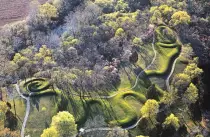
Before the highways, the chain restaurants, the ticky tacky suburbs, and the opiate epidemic, this region held one of the most spiritually advanced civilizations in pre-Columbian North America. The Hopewell people built massive ceremonial earthworks that were geometrically precise, astronomically aligned, and utterly misunderstood by modern archaeology. Mounds shaped like serpents, risen perfect circles that mirrored the moon’s cycles, long avenues pointing to solstices. They weren’t burial plots. They were portals. They were memory-keepers.
Some of those mounds still exist but barely. One plot sits on State Route 104 by a VA hospital. Others were plowed for farmland or paved over for parking lots and strip malls. The remnants are fenced off, sterilized, treated like curious little bumps in the earth instead of sacred spaces crafted by a civilization that understood the relationship between sky, soil, and spirit better than most of us ever will.
And then there’s the matter of names.
“Chillicothe” was a title given to the principal town of the Shawnee. Not a static place, but a rotating seat of spiritual and political power. The name itself means “principal place.” But after the Shawnee were pushed out, white settlers named their new capital after it. They didn’t preserve the culture. They just colonized the name.
That’s what we do in America. We steal the words, scrub the meaning, and sell the illusion of reverence while standing on someone’s grave.
Schools in this area still teach about Native Americans in the past tense. They refer to the Hopewell as “mysterious.” As if they weren’t people. As if their descendants don’t sit quietly in those classrooms while feeling a burn in their chest without knowing why. As if the very geometry of the land doesn’t echo their genius. You can feel it if you sit quietly near the Scioto River or walk through the trails of what we now call “state parks” and “UNESCO World Heritage Centers.” But the trees remember. The dirt remembers. The wind still sings in a language older than English.
This is sacred land. And it’s not mine. But it was my ancestors. I was born here, yes, but that doesn’t make me the inheritor. It just makes me responsible. Responsible for listening. For remembering. For speaking about it.
Because while the history books will reduce these places to dates and treaties, and the homes of uncivilized tribes, the land whispers through tears a different story if you’re willing to hear it.
The mounds were never just dirt. They were data. They were star maps you could walk through.
For decades, archaeologists treated the Hopewell mounds like oversized burial sites but that interpretation barely begins to scratch the surface. Scientific studies now show that these earthworks were deliberately engineered with incredible mathematical and astronomical precision.
Take the Octagon Earthworks in Newark, Ohio. Which was constructed over 2,000 years ago. Researchers have confirmed it functions as a giant lunar observatory, tracking the moon’s complex 18.6-year cycle with accuracy comparable to Stonehenge. The builders aligned it so precisely that, during major lunar standstills, the moon rises within a fraction of a degree of the predicted sightline.
These alignments weren’t random. Hopewell ceremonial centers were often connected by massive linear earthworks, some stretching for miles, which researchers believe marked solstice pathways or connected sacred nodes. Which are what some now describe as ley lines. Ohio’s major mound sites including Mound City, the Newark Complex, and Serpent Mound all appear to form intentional patterns across the landscape, suggesting a sacred geography mapped with astronomical knowledge and spiritual intent.
And it doesn’t stop there.
Ground penetrating radar and remote sensing have revealed subsurface anomalies in many mound sites suggesting unknown chambers, tunnels, or geometric forms never before excavated. Some areas emit measurable electromagnetic fields. Others have long histories of anomalous and supernatural experiences. Everything from UFO sightings to psychic dreams and electrical interference. Even the internet calls Ohio weird for a reason.
There’s something about the soil here. The silence. The symmetry. The pull.
Ask anyone who’s walked the path at Serpent Mound during a solstice or stood alone in the circle at Hopeton Earthworks during a foggy morning. You don’t need a degree to feel the hum. The geometry moves through you. It’s like the land is watching you back.
Modern science is just beginning to grasp what the Hopewell already knew: that the entire earth itself is alive, the sky is a clock, and time is written in patterns, not numbers.
And everything they knew like their math, their moon paths, their monumental alignments? It all still sits under our feet, half remembered, half buried.
What most people don’t understand is that these mounds weren’t thrown together with sticks and mud by pre hominids. They were engineered. Stratified. Built in layers. Some with carefully selected soils, clays, and minerals transported from up to 90 miles away.
That’s not just labor. That’s knowledge. That’s intent.
Some embankments were layered with mica, a naturally reflective mineral, which may have been used to enhance lunar visibility or to channel energetic properties. Possibly a sacred interface between light and earth, akin to the Egyptian pyramids originally being covered in polished limestone. Others used red ochre, powdered stone, and burnt bone, packed with precision to hold form for thousands of years. We’re only just beginning to test for what these substances may have done to conductivity or magnetism over time. The Hopewell didn’t just build structures. They altered terrain.
The spacing of mounds is just as intriguing and intelligent as their structure. The distance between major Hopewell earthwork complexes, like from Newark to High Bank near Chillicothe, forms exact ratios found in geometry, astronomy, and even ancient architecture across the globe. Some researchers believe these alignments may even map out constellations or planetary cycles on a continental scale.
This isn’t conspiracy. This is math.
The Smithsonian, University of Cincinnati, and NASA-affiliated researchers have all publicly acknowledged the geometric and astronomical sophistication of Hopewell design. The Smithsonian calls them “the largest set of geometric enclosures in the world.” NASA-backed astronomers verified their lunar precision. The University of Cincinnati unearthed geometric shapes still pulsing beneath the soil. The Newark Earthworks Lunar Observatory has been modeled and tested using computer simulations that confirm its precision to within half a degree over an 18 year lunar cycle. That’s more accurate than most 19th-century observatories built with telescopes.
“The builders of the Newark Earthworks were also highly skilled astronomers who tracked the movements of the moon with such precision that it rivals that of 18th- and 19th-century European observatories.”
—Dr. Bradley T. Lepper, Curator of Archaeology, Ohio History Connection
Yet public education still calls them "mysterious." As if not understanding something means it wasn’t real. Or advanced. Or human.
And that’s the thing: these people weren’t aliens. They weren’t savages. They weren’t mystical fantasy figures. They were Indigenous engineers, scientists, and artists whose knowledge rivaled anything in ancient Egypt or Babylon. We just don’t talk about it.
Not because it isn’t true. But because it doesn’t fit the narrative.
If they were portals, what were they leading to? If they were trying to tell us something, what are we not listening to? Because if their math was more precise than ours without computers, then what were we supposed to be learning?
Because if they aligned the earth to the sky and some of them now lie under Panera Bread, Ulta, and Five Below then what does that say about us?
Because maybe the mounds were never meant to be understood the way we demand understanding. Maybe they were left for us to feel.
To activate something ancient in our blood and bones. To remind us that knowledge was never just what could be measured. It was what could be remembered.
Because what if the Hopewell didn’t disappear?
What if they simply withdrew, leaving behind circuits of earth and spirit, waiting for someone to notice the hum again? Their beautifully intelligent and astronomical version of “Roanoke” carved into a tree…
And maybe…Just maybe…The hum calls out to certain people on purpose. People born to the land and of the blood. People whose veins still vibrate when pacing in perfect circles under a gray Ohio sky. People who feel a tug in their chest when they pass by a gas station and somehow still know: that isn’t supposed to be there.

I’m not here to decode the mounds.
I’m here to listen to them.
And maybe that’s all they ever wanted.
For those with ears to hear, the soil is still speaking.
Read More... →